
Translate the invisible. Think clearly. Scan with confidence.
Ultrasound Physics & Instrumentation
A Clinical Thinking Tutorial.

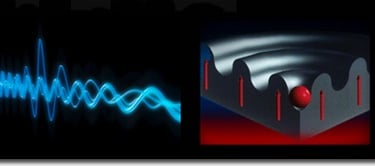
Physics is how nature behaves. In this tutorial, clinicians learn ultrasound physics through tangible, real‑world analogies that replace memorization with understanding.
Tutorial info→
Why This Matters.
Most clinicians don’t struggle with ultrasound physics because they lack ability. They struggle because physics is often taught as something to memorize rather than understand.
The physics and instrumentation exams required for credentialing carry a 35–40% first-time failure rate. Most who fail do so by fewer than ten points. That tells us the problem isn’t intelligence—it’s how the material is taught.
This tutorial approaches physics as what it truly is: the study of nature—how things behave in the real world. Instead of rote memorization, you’ll build a mental model that allows you to reason through any question, whether it appears on a registry exam or at the bedside.
We make the abstract tangible, the invisible visible, and the complex intuitive. You’ll learn the facts required for ARDMS, CCI, and ASRT exams, but more importantly, you’ll learn how to think clearly about ultrasound physics for the rest of your career.
Understanding the Challenge Behind the Physics Exams.
It’s common to approach the physics exam with anxiety—and for good reason. Many capable clinicians fail their first attempt, often by a narrow margin.
This tutorial removes fear by replacing memorization with understanding. When you can reason through cause and effect, you’re no longer dependent on recall alone. You can work through unfamiliar questions with confidence.
Our goal is not to train you to recognize test patterns, but to help you understand the principles well enough that the patterns become obvious.credentialing
Why This Course Is Different.
We don’t teach shortcuts to pass a test. We teach clinicians how to think—so confidence holds at the Registry, at the bedside, and years from now.
Who This Is For.
Clinicians, educators, and professionals who want durable understanding rather than fragile test prep.
The Learning Journey.
Every clinician who enters this tutorial arrives with a different background, experience level, and relationship with physics.
Think of this course as a marker buoy. It stands in clear view, guiding you safely into understanding and back out again—not by forcing a single path, but by helping you orient yourself.
The journey belongs to you. Our role is to provide clarity, steady reference points, and the confidence to continue navigating long after the course is over.
ARDMS Candidate Focus.
For ARDMS candidates, this tutorial builds a unified physics framework that supports SPI preparation and long-term clinical competence. Emphasis is placed on resolution, artifacts, system controls, and Doppler fundamentals—reducing reliance on memorized patterns and strengthening conceptual understanding.
CCI Focus.
For clinicians preparing for CCI credentialing, this tutorial emphasizes hemodynamics, Doppler reasoning, signal interpretation, and clinical correlation. The focus is not formula recall, but understanding velocity estimation, flow behavior, and system limitations as they appear in cardiovascular practice.
ARRT Focus.
For clinicians preparing for CCI credentialing, this tutorial emphasizes hemodynamics, Doppler reasoning, signal interpretation, and clinical correlation. The focus is not formula recall, but understanding velocity estimation, flow behavior, and system limitations as they appear in cardiovascular practice.
Registry Exam FAQ.
Why do many people fail physics the first time?
We believe it's because physics is often taught as memorization rather than cause-and-effect reasoning.
Do I need to memorize formulas?
You need to understand what the formulas describe. Memorization alone is fragile under pressure.
Is this a registry review course?
No. It supports exam success by building understanding that works on unfamiliar questions.
Will this help if I’ve already failed once?
Yes. Many repeat-test candidates succeed once they shift from recall to reasoning.
Which Physics Support Is Right for Me?
New to ultrasound or anxious about physics → Start with the Physics & Instrumentation Tutorial
Preparing for SPI or CCI exam → Physics Tutorial + targeted self-study
Comfortable with basics but struggling with Doppler → Physics Tutorial with Doppler emphasis
Department seeking shared understanding → On-site group tutorial
Individual seeking immersion → Annual Dallas live course
Be in the Room.
Host this tutorial on‑site for your group or join our live annual Dallas session.
On-Site Group Tutorial
Delivered at your facility for a private group. Content is tailored to your equipment, specialty mix, and experience level. Ideal for departments seeking consistent thinking and shared language.
Dallas Live Course
A once-a-year immersive experience bringing clinicians together for focused learning and discussion. Best for individuals or small groups seeking depth, perspective, and mentoring beyond their local environment.
Opening Class Remarks.
"Welcome. Before we talk about equations or terminology, I want to reset expectations.
This is not a course about memorizing answers. It’s about understanding behavior—how sound behaves, how ultrasound machines respond, and how humans interact with both.
If you’ve struggled with physics before, that’s not a failure of intelligence. It’s usually a failure of translation. Today, our job is to translate the abstract into something tangible.
If you leave this session able to reason your way through unfamiliar questions—and explain what you’re seeing at the bedside—we’ve done our job.”
Training Clinicians Worldwide Since 1981.
Testimonials reflect individual learning experiences. Growth in skill and confidence develops through guided training, continued practice, and personal commitment.
Contact
972 | 353-3200 USA Central Time
Course Campus:
4300 Wingren Drive
Irving (Las Colinas), Texas 75039
Mail | FedEx Address:
Box 101
Colleyville, TX 76034
Courses & Learning
Ultrasound Physics
Cardiovascular Hemodynamics
EKG- From Atoms to Arrhythmias